 how-to
How to Cast a Fly Rod From a Drift Boat
Table of Contents
- Why Casting From a Drift Boat Is Different
- Safety First: Knee Locks and Footing Before You Cast
- Setting Up Your Rod, Line and Gear at the Ramp
- Reading River Currents for Better Fly Presentation
- Casting Zones, Boat Positioning and Casting Angles
- Water Load Casting Techniques for Tight Spaces
- Fly Line Management in a Drift Boat
- Working With Your Oarsman and Managing Wind
- Frequently Asked Questions
Why Casting From a Drift Boat Is Different
Learning how to cast a fly rod from a drift boat is not the same as casting from a riverbank.
Most casting advice assumes solid ground and a clear back cast.
At River People Guides, we tell every new angler the same thing: learn to read the boat's motion before you learn to read the water.
Three things make boat casting its own skill:
- The platform moves. You have to time your cast to the boat's rhythm, not to a fixed stance.
- Your casting space is limited. Trees, banks, and the oarsman all take up room behind and beside you.
- You fish from the front. You have to make longer, more accurate casts while the boat carries you past the target.
Anglers who have fished from the bank for years often find their timing and back cast habits need only small changes when they move to a boat.
Safety First: Knee Locks and Footing Before You Cast
Your footing is the foundation of every cast.
A knee lock means bending your knees slightly and bracing your legs against the boat's seat or floor to keep your balance steady when the boat rocks.
Follow these steps before every cast:
- Stand with your feet shoulder-width apart.
- Bend your knees a little, and keep your weight low.
- Brace one leg against the seat or the boat's frame.
- Hold the rod with one hand and grip the boat with the other.
Watch out: Never stand on the bow with your back to the oarsman without a firm grip on the boat.
Some anglers wear felt-soled wading boots on the boat, which help with grip. Others prefer non-marking rubber soles.
Setting Up Your Rod, Line and Gear at the Ramp
Good setup before you launch saves frustration on the water. Most problems on the first casts come from gear that is not ready.
Start by checking your rod and reel. You can browse our reel selection to see what fits your setup.
Next, match your fly line to the rod. You can compare fly lines against your current line.
Set up your gear in this order:
- Attach the reel and thread the line through the guides.
- Tie on your leader and tippet, checking the knots.
- Clip your flies to a fly patch or box within easy reach.
- Stow loose gear so nothing rolls under your feet.
Keep a few extra leaders, a clipper, and a net within reach. Pack everything in a way that lets you grab it without moving around the boat.
Reading River Currents for Better Fly Presentation
Once you are on the water, the current tells you where to cast. A good fly presentation depends on how the water moves under and around your fly.
Look for these current features:
- Seams: Lines where fast and slow water meet. Trout often hold just off the faster side.
- Eddies: Slower water behind rocks or banks where food collects.
- Tongues: Smooth, V-shaped water flowing down from riffles into deeper pools.
Your oarsman can help here by slowing the boat or holding a position so you can make a longer, controlled drift over a target, giving you a clean drift instead of a fly that skates across the surface.
Casting Zones, Boat Positioning and Casting Angles
Think of the boat as having casting zones, each giving you a different angle and reach to the water.
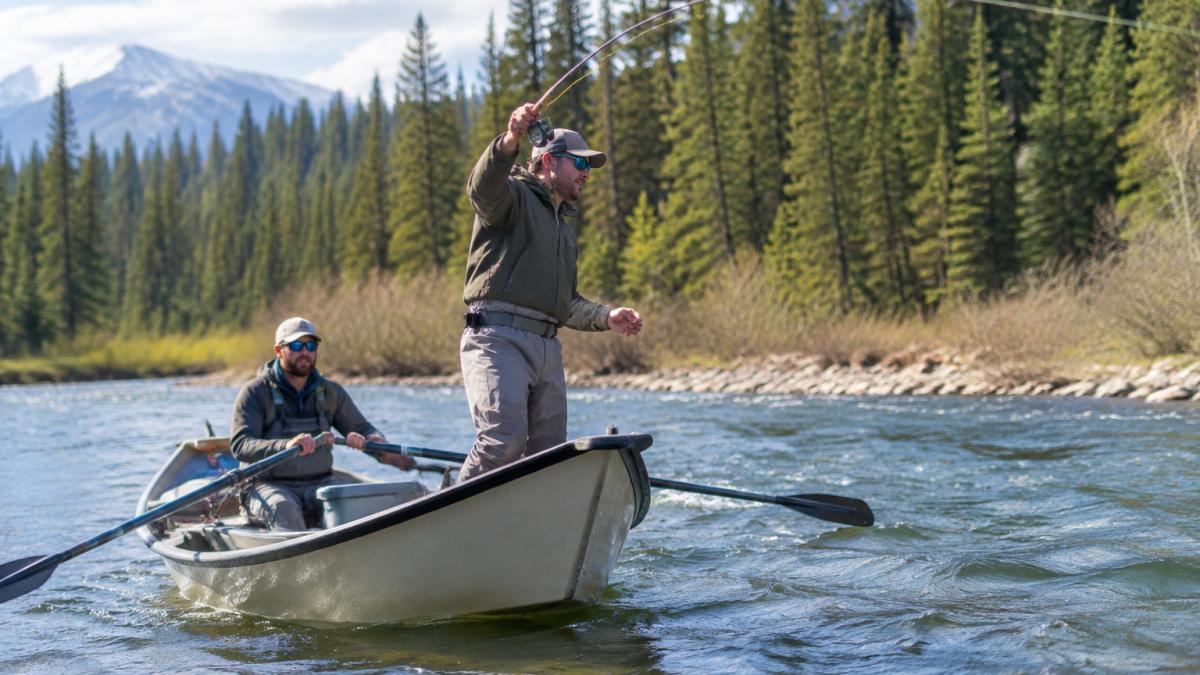
The front of the boat gives you the widest view and the longest casting space. The side gives you a shorter, tighter cast toward the bank. The stern is where the oarsman usually works, so you should rarely cast there.
Your casting angle changes the cast. A low, side-arm cast works well under overhanging branches, while a higher overhead cast suits open water.
Upstream Versus Downstream Casts
Upstream casts put your fly ahead of the boat so the current carries it back toward you.
Downstream casts send the fly across or down the current. They are useful for covering water quickly but often create drag, which pulls the fly unnaturally.
Most common mistake: anglers cast downstream out of habit and then wonder why their flies drag. Try an upstream cast first, then mend your line to reduce drag.
Adjusting the Cast for Boat Beam Width
Boat size changes how much room you have, but beam width is the number that should drive your backcast arc.
On a narrow boat, keep your backcast steep and compact.
On a wider boat, you can open the arc and use a more relaxed overhead stroke.
A simple field test: stand in the boat at the ramp and have a partner hold a rod vertically at the beam's edge.
Boat Positioning Cues for the Angler
Pick your target before the boat reaches it, then call the angle you need, 'ten feet off the left bank' or 'hold on this seam,' rather than waiting until you are past it.
The boat's beam width and your casting angle determine how much room you have, so the table below summarizes the cast choices the article describes.
| Cast type | Best for | Key difference |
|---|---|---|
| Upstream cast | Natural drift fishing | Fly drifts at current speed |
| Downstream cast | Covering water quickly | Often creates drag |
| Narrow boat (about 1.2 meters beam) | Tight, steep backcast | Compact V-shaped line path |
| Wide boat (1.8 meters or more) | Open, relaxed overhead stroke | Wider loop, more distance |
Water Load Casting Techniques for Tight Spaces
Sometimes there is no room for a full back cast. Overhanging trees, a narrow channel, or a crowded boat all limit your movement. Water load casting solves this problem.
A water load cast uses the water's tension to load the rod instead of a back cast: you lay the line on the water behind you, then lift and drive it forward as the water resists the line.
Here is how to do it:
- Hold the rod tip low and let the line fall on the water beside the boat.
- Lift the rod smoothly, bringing the line off the water in one motion.
- Pause briefly as the line loads the rod.
- Drive the rod forward toward your target and stop it firmly.
Water load casting works well for short to medium distances. It takes practice, so start with short casts in open water before you try it near the bank.
Fly Line Management in a Drift Boat
Line management separates a smooth day from a tangled one. Loose line on the boat floor is the number one source of snags.
Keep your line organized by:
- Stripping line into a dry bag, line tray, or hand-held loops.
- Keeping the line off your feet and away from the oarsman's gear.
- Checking that the reel's line is not caught on any seat, cooler, or rod holder.
Strip line in loops rather than piling it on the deck. Loops come off the boat cleanly when you cast. Piled line tangles fast.
Use a short, controlled haul when you need more line. Long, sloppy strips send loops across the boat.
Preventing and Clearing Common Tangles
Most tangles come from three causes: slack line on the deck, a fly caught on gear, or a wind knot during a cast.
To prevent tangles:
- Keep only a few feet of loose line outside the reel.
- Check your fly after each fish.
- Avoid casting into the wind with a long leader out.
To clear a tangle, stop casting and pull the line gently back toward your reel. Work out one loop at a time with your fingers. Forcing a tangle makes the knot tighter.
Working With Your Oarsman and Managing Wind
Your oarsman is your partner on the water. Clear communication keeps the boat in position and your casts on target, and on windy days that partnership matters even more.
Agree on a few simple signals before you launch. For example, a tap on the shoulder can mean 'slow down,' and a hand pointed at a spot can mean 'hold here.' Set these up before the first run so you do not have to shout over the river.
Visual Cues for the Oarsman
Verbal commands get lost over wind and water, so build a small vocabulary of hand signals. Most guides respond well to three or four signals that cover the common requests:
- Flat palm held up: stop or hold the boat in place.
- Point at a spot on the water: move the boat toward that target.
- Hand patting the air downward: slow the drift.
- Fist raised: I need a moment to clear a tangle, hold position.
Practice these at the ramp before you push off. A guide who has seen your signals once will read them faster than a shouted instruction on the first cast.
Wind Management in a Moving Vessel
Wind changes everything. A strong headwind pushes your fly back toward you, while a crosswind pulls the line sideways. The boat's own motion compounds the problem, because you are casting from a platform that is already drifting.
Try these adjustments:
- Headwind: Cast lower and use a tighter loop. A high backcast catches the wind and collapses. Shorten your stroke and aim the rod tip just above the water.
- Crosswind: Angle your casting plane into the wind rather than fighting it. If the wind comes from your left, tilt your rod slightly left so the line travels upwind of your target and the wind carries it back on line.
- Tailwind: You can open your loop and lengthen the stroke, but watch for the line piling up behind you on the deck. Tailwinds hide slack line.
- Boat moving into the wind: Time your forward cast to the boat's forward surge. Casting as the boat accelerates into a gust is how lines end up under the hull.
Wind management in a moving vessel improves with time. Start in calm conditions, then work into breezier days as your confidence grows.
Ready to put these techniques into practice? Book a guided trip with River People Guides and let our team help you refine your casting on the water. We also offer private fly fishing instruction for anglers who want focused help with boat casting, and our guide to improving your fly casting technique covers the mechanics in more depth.
Frequently Asked Questions
What is the best casting technique for a drift boat?
The most reliable technique on a drift boat is a short, compact stroke with a firm stop, because the boat is moving and wide loops tend to catch the oarsman, the rod tip or the surrounding trees. Most experienced anglers keep the backcast within a small arc above the bow and let the line unroll in front of them. Practise the stroke on the lawn before your trip, then carry the same rhythm onto the water.
How do you manage fly line in a drift boat to avoid tangles?
Strip only the amount of line you plan to cast, and keep the rest coiled loosely in a line hand or on the deck rather than dropping it at your feet. Good fly line management in a drift boat means keeping the leader and tippet off the floor, away from the oars and out from under the knee locks. Before each cast, check that the line is clear of the reel and the boat's gear. When a tangle does form, stop casting, lay the rod down and clear it by hand instead of forcing the cast, which usually makes the knot tighter.
Should you cast upstream or downstream from a drift boat?
Both have a place. Upstream casts give the fly a longer drag-free drift over the target, which suits technical water and cautious fish, while downstream casts are easier to control in a fast current and keep the line from building up in front of the boat. Read the current before you choose: if the line will sweep toward the bank or the boat faster than the fly drifts, adjust the angle. Mending the line after the cast gives you the same effect in either direction.
What are the safety rules for fly fishing from a drift boat?
Stay seated or braced with both knees locked when standing, keep your footing on the boat's floor and never stand up on the bow while the oarsman is running a rapid. Keep the rod tip low and tell the oarsman before you make a long cast or change position, so they can hold the boat steady. Store loose gear and tippet spools in the boat, and watch for overhead branches and power lines along the bank. These habits protect both the angler and the guide, and they are the first things an experienced oarsman will expect from you.