 how-to
Improve Your Fly Casting Technique: A Guide
Table of Contents
- Master the Fundamentals of Fly Casting Technique
- How to Improve Your Back Cast for Better Control
- Fly-Casting Accuracy Drills to Sharpen Your Placement
- Common Fly-Casting Mistakes and How to Fix Them
- Fly-Casting Practice Drills for Beginners
- Casting in Local Conditions: Wind and Water
- Frequently Asked Questions
Last Updated: October 11, 2026
Master the Fundamentals of Fly Casting Technique
Improving fly casting technique starts with mastering core mechanics. Anglers who nail the fundamentals see dramatic improvements in distance, accuracy, and control.
The casting stroke is the foundation: timing, rhythm, and understanding how your rod loads and unloads energy, not arm strength or speed.
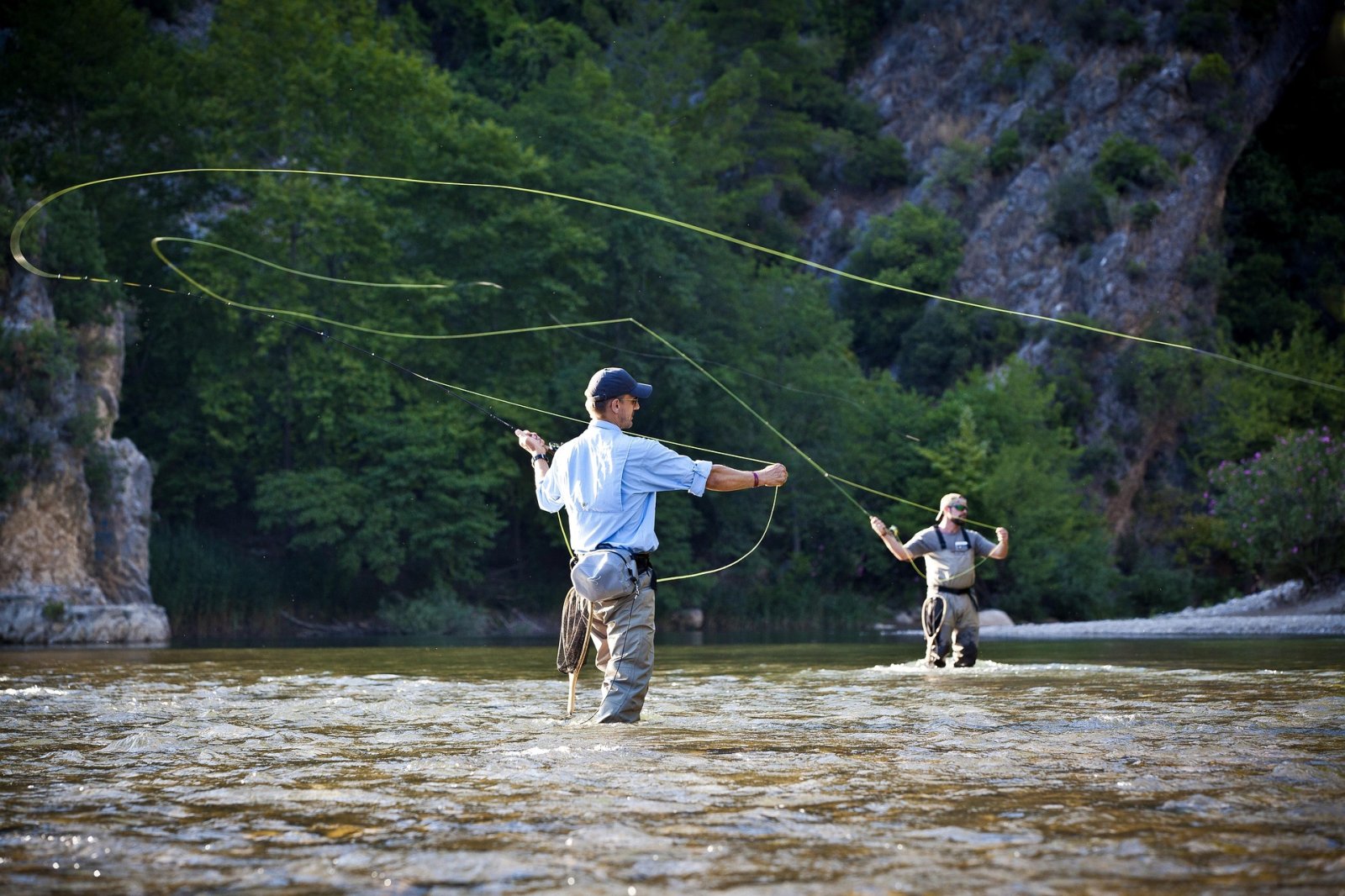
Fly angler demonstrating proper grip and casting stance by a river, showing arm position and rod angle during the forward cast motion
The Casting Stroke and Rod Loading
Rod loading is everything. When you move the rod backward, the line weight bends it, storing energy. When you accelerate forward and stop hard, that energy transfers to the line.
Each casting stroke requires smooth acceleration followed by a crisp stop. A hard stop creates a tight loop; a soft stop creates a tailing loop that collapses and kills distance.
Load your rod by moving it from 2 o'clock to 10 o'clock on the back cast, roughly a 90-degree arc. Larger arcs waste energy and create timing problems.
Forward Cast and Back Cast Mechanics
The forward cast mirrors the back cast: accelerate smoothly from 10 o'clock to 2 o'clock, then stop hard. The stop creates the tight loop that carries your line and fly to target.
Timing between back and forward casts is critical. Wait for the line to straighten behind you before accelerating forward. Starting too early causes collision, creating tailing loops or wind knots.
The pause creates rhythm. Count one-thousand-one on the back cast, then one-thousand-two before the forward cast. This rhythm prevents rushing.
Power application is simple: accelerate smoothly, then stop hard. No jabbing or muscling.
How to Improve Your Back Cast for Better Control
Your back cast determines everything that follows. A weak back cast means a weak forward cast.
To improve your back cast, feel the rod load. Cast into slight wind for feedback; it slows the line, letting you feel the rod bend.
Keep your back cast tight and high, traveling straight behind you. A 90-degree arc is enough; anything beyond wastes energy and creates slack.
Fly-Casting Accuracy Drills to Sharpen Your Placement
Accuracy drills train you to recognize the exact moment to stop your casting stroke. Place a hula hoop approximately 9 metres away and cast into it 10 times, recording your score each session.
Drill |
|---|
Distance |
Repetitions |
Goal |
Circle casting |
Approximately 9 metres |
10 casts |
8/10 inside circle |
Progressive distance |
Approximately 9-15 metres |
5 casts each |
Consistent placement |
Wind casting |
Variable |
10 casts |
Adjust for crosswind |
Accuracy under pressure |
Approximately 10.5 metres |
20 casts |
15/20 on target |
Common Fly-Casting Mistakes and How to Fix Them
Casting faults have visible symptoms. Diagnose the cause, not just the symptom, to fix problems at their root.
Tailing Loop (Line Collapses or Crosses Over Itself)
Root causes:
- You start the forward cast before the back cast line has fully straightened.
- Your back cast stop is too soft or too late, leaving slack in the line.
- Your forward cast acceleration is too slow, failing to load the rod.
How to fix it:
- Lengthen the pause between casts. Count "one-thousand-one" after your back cast stops, waiting for full line extension.
- Make your back cast stop crisp and hard, not soft.
- Accelerate smoothly through the forward cast, then stop hard. A soft forward-cast stop signals a tailing loop.
Drill to fix it: Cast into a slight headwind to feel when the line straightens, then start your forward cast at that moment.
Wind Knots (Overhand Knots in the Leader or Tippet)
Root causes:
- Pause between casts is too short, causing collision.
- Casting arc is too large, creating slack.
- Loop is too open, allowing the line to cross itself.
How to fix it:
- Increase the pause between casts by one full count.
- Tighten your casting arc to 90 degrees (2 o'clock to 10 o'clock).
- Make your stops harder and crisper. Soft stops create open loops that tangle.
Slack Line (Loose Line Between Rod Tip and Fly)
Root causes:
- Forward cast stop is too soft, failing to transfer energy.
- You're jabbing or decelerating instead of accelerating smoothly.
- Rod is not fully loaded on the back cast.
How to fix it:
- Accelerate smoothly, then stop hard. No jabbing or slowing down.
- Ensure your back cast fully loads the rod. Feel the bend. If not, move the rod farther or faster.
- Accelerate all the way to the stop on the forward cast. Don't decelerate early.
Poor Turnover (Fly Does Not Straighten or Lands Sideways)
Root causes:
- Loop is too open or slow. Tight, fast loops turn over cleanly.
- Fly is too large or wind-resistant for your distance.
- Leader is too long or heavy for the fly size.
How to fix it:
- Tighten your loop with crisper stops and faster acceleration.
- Shorten your leader by approximately 15 to 30 centimetres.
- In wind, shorten your stroke slightly and accelerate faster.
Inconsistent Distance (Casts Vary Wildly in Length)
Root causes:
- Casting stroke varies: arc length, acceleration, or stop timing changes cast to cast.
- Pause between casts is inconsistent.
- Rod loading is variable.
How to fix it:
- Use the clock drill, casting to the same target repeatedly.
- Use the metronome drill to lock in rhythm.
- Record yourself on video and compare three consecutive casts. Identify what changes and correct it.
Line Speed Too Slow (Fly Does Not Travel Far or Lands Softly)
What you see: The fly seems to float rather than shoot. Distance is limited even with a long cast.
Root causes:
- Acceleration is too slow. Line speed comes from crisp acceleration, not arm speed.
- Stop is too soft, failing to transfer energy.
- Rod is not fully loaded.
How to fix it:
- Accelerate faster through the stroke. Smooth, fast acceleration beats jerky, slow movement.
- Stop harder. A hard stop creates high line speed; a soft stop creates low line speed.
- Load the rod fully on the back cast. Feel the bend.
Drill to fix it: Cast into a headwind. Wind pushes back if line speed is too slow. As you increase line speed, wind resistance decreases, providing feedback.
Using Video for Self-Diagnosis
Record yourself casting from the side and behind. Watch for back cast drift, pause consistency, stop crispness, and loop shape. Compare to a reputable casting video, identify one difference, fix it for one week, then record again. This iterative approach builds skill faster than random practice.
Fly-Casting Practice Drills for Beginners
Effective practice requires structure. Below is a four-week framework for beginners practicing on grass or in a safe water area.
Week 1: Rod Loading and Timing
Focus on feeling the rod load and developing rhythm.
- The load-and-pause drill: Make 10 back casts, pause for a full count, then 10 forward casts. Repeat five times. Goal: Feel the rod bend on every cast.
- The metronome drill: Use a metronome app at 60 BPM. One back cast per beat, pause one beat, one forward cast per beat. Repeat 5 minutes. Goal: Stay in rhythm without rushing.
Week 2: Back Cast Control and Consistency
Add a target. Focus on the back cast line traveling straight and high.
- The clock drill: Imagine your body at the center of a clock. Cast to 12 o'clock 10 times without letting the line touch water (false casting). Repeat at 1, 2, and 3 o'clock. Goal: Back cast line stays straight in all directions.
- The distance-hold drill: Cast to approximately 9 metres and hold the line in the air for three false casts before landing. Repeat 10 times. Goal: Line stays tight and straight during the pause.
Week 3: Forward Cast Accuracy and Placement
Introduce a physical target and measure success.
- The circle drill: Mark a 3-metre circle at approximately 9 metres. Cast into it 10 times. Goal: Land 8 out of 10 inside. Track your score each session.
- The progressive-distance drill: Mark targets at approximately 7.5, 9, 10.5, and 12 metres. Cast five times to each, then repeat the sequence three times. Goal: Consistent placement at each distance.
Week 4: False Casting and Line Control
Build rhythm and line management for real-world fishing.
- The false-cast progression: Start with three false casts before landing, repeat 10 times. Next session, do four. Progress to five, six, and seven over subsequent sessions. Goal: Maintain a tight loop through five false casts without collapse.
- The accuracy-under-false-casting drill: Make three false casts, then land on a 10.5-metre target. Repeat 10 times. Goal: Land 7 out of 10 on target.
Tracking Progress
Keep a simple log: date, drill name, goal, result, and notes. Example:
Date |
|---|
Drill |
Goal |
Result |
Notes |
Nov 15 |
Circle drill |
8/10 in circle |
6/10 |
Back cast drifting left |
Nov 17 |
Circle drill |
8/10 in circle |
8/10 |
Adjusted stance, improved |
Nov 19 |
False-cast progression |
5 false casts, tight loop |
4/5 tight |
Loop collapses on 5th cast |
This log reveals patterns. If you consistently miss left, your back cast likely drifts. If your loop collapses after four false casts, you need more rod loading or a crisper stop.
Practice Frequency and Duration
Practice 20-30 minutes, three times per week. Short, focused sessions consolidate learning. Rest at least one day between sessions.
When to Move to Water
Once you consistently land 8 out of 10 casts at 10.5 metres on grass and maintain a tight loop through five false casts, move to water. Grass teaches mechanics; water teaches adaptation to current and wind.
Casting in Local Conditions: Wind and Water
Local rivers present specific casting challenges. Headwind slows line speed, requiring a tighter loop and faster acceleration. Crosswind pushes your line sideways, requiring compensation.
In a headwind, shorten your stroke slightly and accelerate faster. A tight loop punches through wind better than a loose one. Speed comes from crisp stops, not arm strength.
For crosswind, angle your body so the wind is at your back or quarter-back. Cast slightly into the wind to let it push your line toward the target.
Water conditions matter. Faster current requires a heavier fly line; slower, spring-fed streams allow lighter lines. River People Guides can help you match equipment to local conditions. The Bow River near Bragg Creek presents moderate current and occasional wind; the Elbow River is typically slower and calmer. Local knowledge makes the difference.
Improving fly casting technique requires patience, focused practice, and honest feedback. The fundamentals, rod loading, timing, and crisp stops, are learnable for any angler willing to spend time on them.
Frequently Asked Questions
How can I improve my fly-casting technique?
Focus on three core elements: rod loading (bending the rod to store energy), timing your pause between forward and back casts, and smooth power application throughout the stroke. Practice the fundamentals with short distances first, then gradually extend your range. Work on one aspect at a time—master loop control before attempting distance, and refine accuracy before tackling wind conditions. Consistent practice drills, even 15-20 minutes weekly, build muscle memory faster than occasional longer sessions.
What are the most common fly-casting mistakes?
Beginners often apply power too early in the stroke, creating tailing loops and poor line control. Over-rotating the wrist causes the rod tip to drop, reducing distance and accuracy. Failing to pause between forward and back casts collapses the loop. Rushing the acceleration phase prevents proper rod loading. Many anglers also cast too hard instead of letting the rod's flex do the work. Diagnosing which mistake you're making—by watching your loop shape and where your fly lands—is the first step to fixing it.
How do I improve accuracy when fly casting?
Accuracy drills train your eye and arm coordination. Start with the target-zone drill: place markers at 7, 9, and 11 metres and practice landing your fly within a metre of each. Use the double-haul technique to control line speed and placement more precisely. Focus on a consistent casting stroke—tiny adjustments in rod angle and timing matter far more than power. Practice casting to specific features like rocks or current seams. Reduce false casts to only what you need; extra false casts introduce variables that hurt accuracy.
How often should I practice fly casting?
Consistent, shorter practice sessions beat occasional long ones. Aim for 20-30 minutes, 2-3 times weekly, on grass or water. This frequency builds and maintains muscle memory without fatigue that leads to poor technique. Before guided trips or fishing days, spend 10-15 minutes warming up your casting stroke. During fishing, every cast is practice—focus on technique even when you're not catching. Beginners benefit from more frequent practice; experienced anglers maintain skills with weekly sessions.