 how-to
Learn Fly Fishing for Beginners: A Step-by-Step Guide
Table of Contents
- Before Your First Cast: What You Need to Know
- Essential Beginner Fly Fishing Gear
- How to Cast a Fly Rod: Fundamentals for New Anglers
- Fly Fishing Lessons for Beginners: Building Your Skills
- Guided Fly Fishing Trips for Beginners
- Timing, Seasons, and River Conditions for Success
- Your Path Forward: From First Cast to Independent Angler
- Frequently Asked Questions
Last Updated: October 12, 2026
Before Your First Cast: What You Need to Know
To learn fly fishing, beginners don't need years of experience or expensive gear, just the basics before you hit the water. At River People Guides, we work with beginners constantly, and the answer to whether fly fishing is for them is almost always yes, if you start the right way.
Fly fishing combines technique, patience, and local knowledge. All three can be learned: start with fundamentals, add local knowledge gradually, and let technique develop through practice.
Before booking a trip or buying gear, handle the practical requirements: provincial regulations, your licence, and a realistic sense of a first day.
Provincial Fishing Regulations and Licensing
You need a valid fishing licence to fly fish anywhere in the province. Fishing without one carries penalties.
Provincial licences come in a few options:
- Annual resident licence: covers the full calendar year
- Short-term licence: available for 7 days or 14 days if you're visiting
- Conservation licence: lower cost, applies to specific waters
You can purchase a licence online through the provincial government's environment or fish and wildlife agency or at most tackle shops, including River People Guides. The process takes minutes.
The province also has rules about where you can fish, what you can keep, and seasonal closures. Some waters are catch-and-release only; others have daily limits.
Check current rules before you go; what was legal last year might not be this year. Your guide knows the rules, but compliance is your responsibility. River People Guides can point you to official provincial regulations when you book.
First-Trip Checklist for Beginners
Your first day goes better if you're prepared. The essentials:
Before you go:
- Purchase or confirm your provincial fishing licence
- Check weather forecast and water conditions for your chosen date
- Wear layers; river weather changes fast
- Bring sunscreen and a hat
- Pack water and snacks (fishing is hungry work)
- Wear shoes with grip (wet rocks are slippery)
- Tell someone where you're going and when you'll be back
Gear to bring:
- Your rod, reel, and line (or rent from River People Guides)
- Wading boots or waterproof shoes
- Waders if the water is cold (it usually is)
- A small backpack for your gear
- Flies in a few basic patterns
- Sunglasses to see into the water
Mental preparation:
- Expect to catch nothing on your first outing, and be thrilled if you do
- Plan to spend more time learning than fishing
- Accept that casting takes practice; you won't be smooth on day one
- Remember that fly fishing is as much about being on the water as catching fish
Essential Beginner Fly Fishing Gear
You don't need to spend a fortune or buy everything at once. Many beginners rent gear for their first few trips, then invest once they're committed.
The basics are simple: a rod, a reel, a line, and flies. Everything else is refinement.
Rod, Reel, and Line Basics
Your rod transfers power from your arm to the line and fly.
Beginner rods typically run 8 to 9 feet.
The reel holds your line.
Your line connects rod to fly. Fly line is thicker and heavier than spinning line, designed to carry the fly's weight.
Below the fly line is the leader, a thinner section connecting to your fly. It's mostly invisible to fish and lets your fly land delicately.
River People Guides carries quality beginner rods from trusted brands. Renting before buying is smart; you'll know your preference after a few outings.
Wading Gear and Safety Equipment
You'll be standing in the river, so wading gear matters for comfort and safety.
Waders are waterproof pants that let you wade deeper without getting wet.
Wading boots go over your waders and have sticky soles that grip wet rocks. Slipping is dangerous and embarrassing; good boots prevent both.
A wading belt goes around your waist. If you fall in, it slows water rushing into your waders and pulling you down.
Bring a small backpack or chest pack for flies, extra line, and tools. You don't need much, but organization makes fishing more enjoyable.
Sunglasses are essential: they protect your eyes and let you see into the water.
How to Cast a Fly Rod: Fundamentals for New Anglers
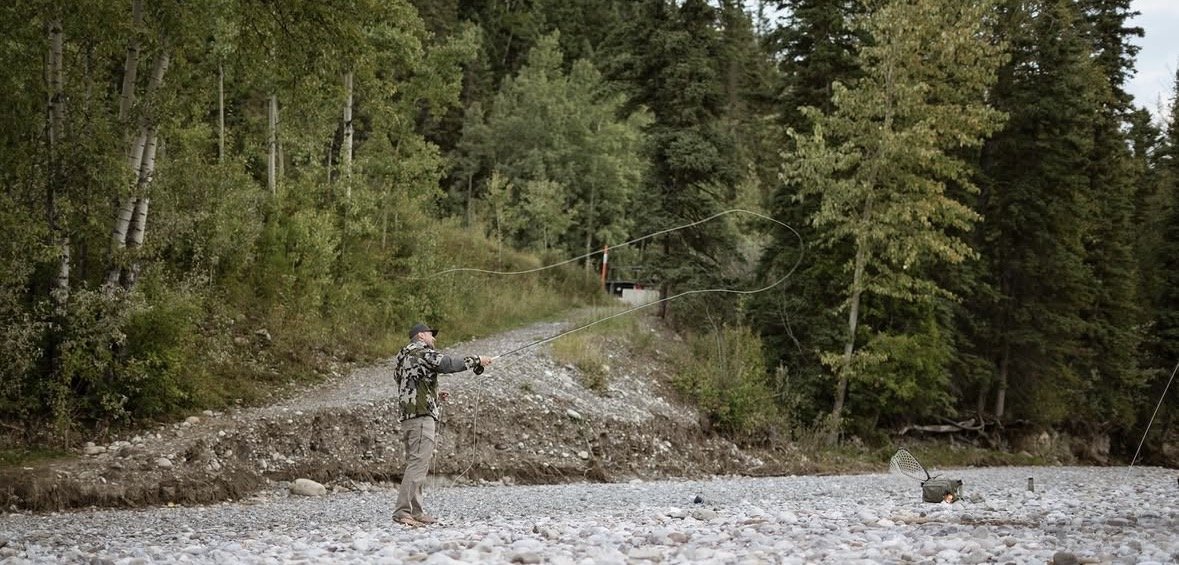
Casting separates fly fishing from other angling. It looks graceful when done well and awkward when you're learning; both are normal.
The fly rod cast is not a throw. It's a controlled motion that transfers energy from your arm through the rod to the line and fly, smooth, not jerky, about timing, not strength.
Grip, Stance, and Casting Motion
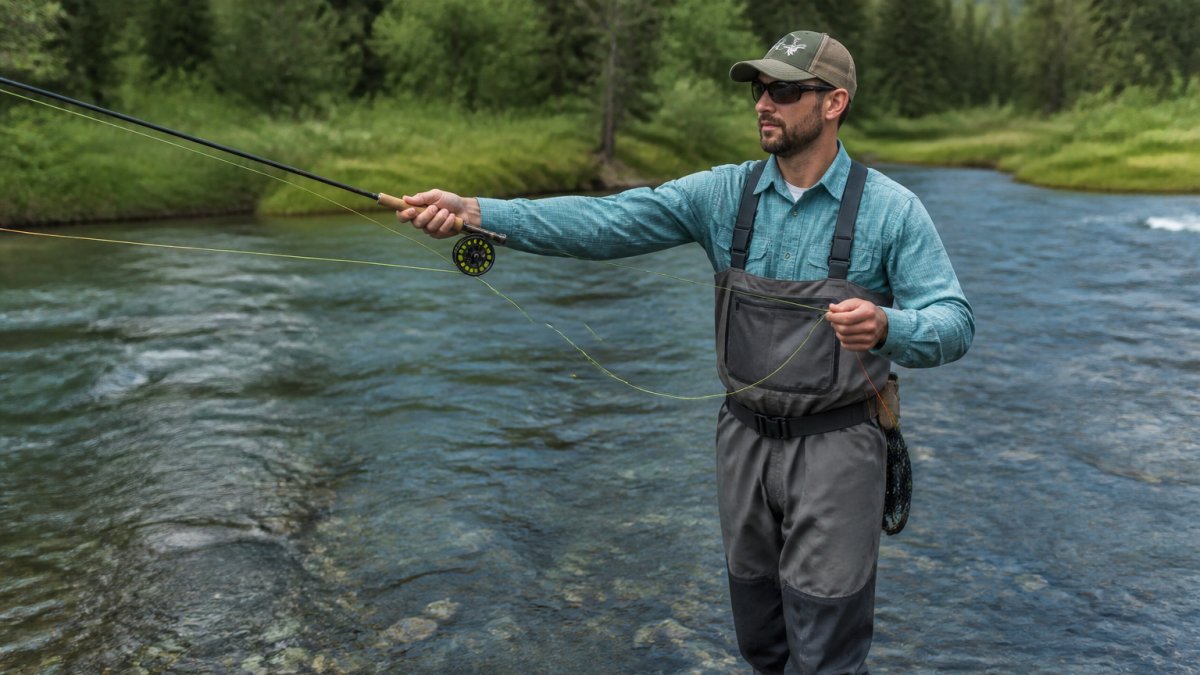
Hold the rod with your thumb on top of the handle, fingers wrapped underneath.
Stand with feet shoulder-width apart, facing your target with your body slightly angled. Keep your weight balanced, not leaning forward or back.
The cast has two parts: the backcast and the forward cast.
The backcast: Raise your rod hand to waist height, then accelerate smoothly up and back to about 1 o'clock, elbow close to your body.
Practice on grass before hitting the river. Muscle memory matters; the motion should feel smooth and rhythmic, not rushed.
Common Casting Mistakes and How to Fix Them
Most beginners make the same casting mistakes. Knowing them helps you avoid them.
Mistake: Casting too hard. You need timing and smooth acceleration, not strength. Muscling the rod tenses your arm and ruins the cast.
Mistake: Not waiting for the backcast to load. Starting forward before the line extends behind you kills distance and accuracy.
Mistake: Stopping the rod too late. Drifting past 10 o'clock splashes the fly and scatters fish. The fix: stop at 10 o'clock every time.
Mistake: Using only your arm. Good casting uses shoulder, elbow, and wrist together. Isolating your arm limits power and control.
Practice these fixes one at a time.
Fly Fishing Lessons for Beginners: Building Your Skills
Fly fishing lessons for beginners accelerate learning. A good instructor shows your mistakes and how to fix them; without feedback, bad habits lock in fast.
Casting Practice and Progression
Casting improves through repetition, but only correct practice. Bad practice reinforces bad habits.
Start on grass, no water, no pressure. Focus on the motion: 20 casts, rest, 20 more. Your arm will fatigue; stop before exhaustion.
Once the motion feels natural, move to shallow water where you can see the bottom. Cast to targets: a rock, a patch of weeds, a spot on the far bank. Accuracy matters more than distance.
Distance comes later. A 30-foot cast placed perfectly beats a 60-foot cast in the wrong spot.
Practice 2-3 times weekly if you can. Two 30-minute sessions beat one 2-hour marathon.
Understanding Trout Behavior and Presentation
Fly fishing works because trout eat insects. Your job is presenting a fly that looks like one they want to eat.
Trout hold where the current brings food but they can escape quickly. Look for deeper holes, undercut banks, and areas behind large rocks.
Trout face upstream, watching for food floating down.
Presentation matters more than the fly: a mediocre fly presented perfectly outfishes a perfect fly presented poorly.
Watch the water. See where the current moves. Understand how your fly drifts. These observations teach you more than any book.
Guided Fly Fishing Trips for Beginners
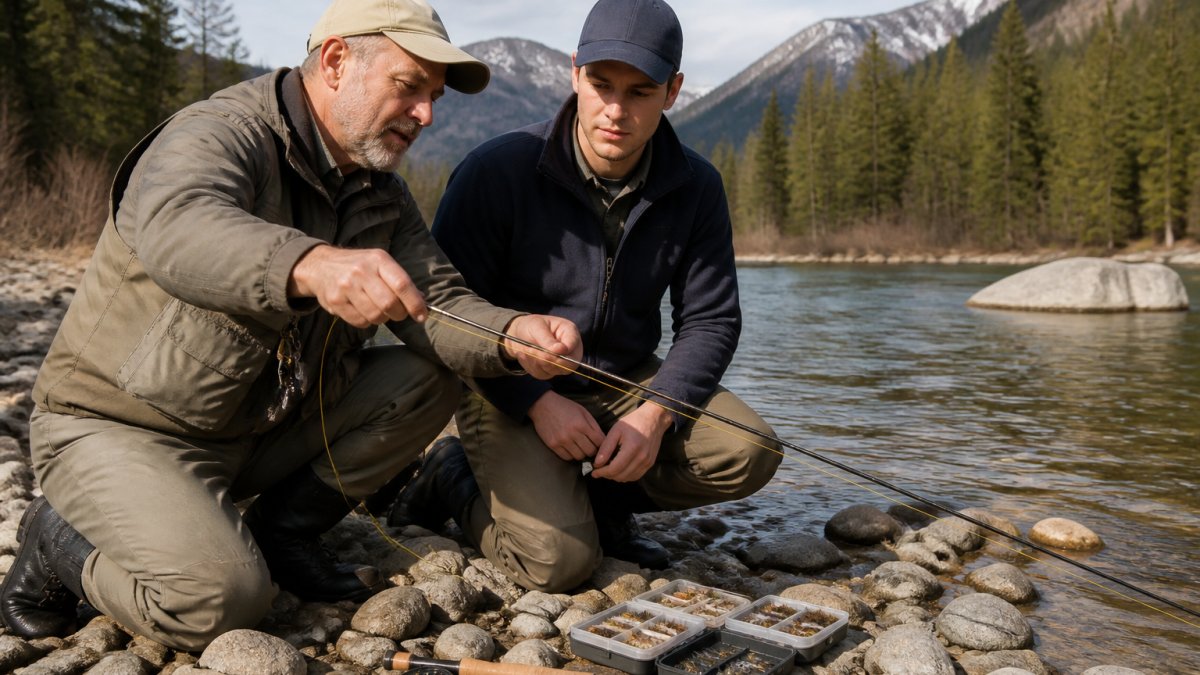
A guided trip accelerates learning. Your guide handles logistics, knows where fish are, and teaches as you fish, so you focus on casting.
What to Expect on Your First Guided Trip
Your guide meets you early, usually before dawn. The Bow River fishes best in early morning and late evening when trout feed actively.
Your guide assesses your skill in the first 30 minutes, watching you cast and adjusting the day accordingly. River People Guides matches the pace to you.
You'll wade, cast, and fish all day. Your guide shows you where to cast, what fly to use, and how to read the water, correcting your casting in real time.
Expect a few fish on your first day, or none, which is also normal.
Bring water, snacks, and sunscreen. Wear layers. The weather changes fast.
River Access Points and Local Waters
The Bow River near Calgary has several access points where beginners can fish safely. Not all are equally good for learning.
Popular beginner sections include areas with slower current, visible structure (rocks and logs), and clear water where you can see fish.
Your guide knows which sections suit your skill level each day. Water levels change with snowmelt and upstream dam releases, so your guide adjusts to current conditions.
Some sections are private, some require permission, some are crowded. Your guide handles these logistics.
River People Guides knows the Bow River intimately, understanding where beginner-friendly trout hold at different times of year.
Timing, Seasons, and River Conditions for Success
Fly fishing works better at some times than others. Timing dramatically improves your success.
Spring (April-May) brings snowmelt: rising water, dropping clarity, and aggressive feeding before fish disperse. Beginner success is moderate.
Summer (June-August) means lower, clearer water and pickier fish, so casting accuracy matters more.
Fall (September-October) brings cooler water and aggressive feeding. Fish prepare for winter.
Winter (November-March) means cold water and fewer fish, with some sections closed. Fishing is possible but challenging.
Water level matters. High water makes wading dangerous and fishing difficult.
Time of day matters too: the first two hours after sunrise and last two before sunset are prime feeding windows.
Your Path Forward: From First Cast to Independent Angler
Your first trip is the beginning, not the destination. Fly fishing is a sport you can practice for a lifetime and never master completely.
After your first guided trip, you'll know whether you want to continue.
Most beginners benefit from guided trips over a few months. Each teaches something new; between trips, practice casting and fish on your own.
River People Guides supports anglers at every stage with beginner lessons, intermediate workshops, advanced trips, and gear for every skill level.
The goal isn't to make everyone an expert. It's to get you comfortable on the water, confident in your abilities, and excited to return.
Fly fishing rewards patience and practice. We offer guided trips tailored to your skill level, professional instruction on casting and presentation, and access to premium gear from trusted brands. Book your first guided trip and discover why fly fishing on the Bow River is worth your time.
Frequently Asked Questions
How long does it take to learn fly fishing as a beginner?
Most beginners grasp basic casting within a few hours of practice and can start catching fish on guided trips within one or two outings. Developing proficiency, understanding fly selection, reading water, and improving presentation typically takes weeks of regular practice. The learning curve accelerates significantly with professional instruction and hands-on experience on actual rivers rather than casting practice alone.
What gear does a beginner really need to start fly fishing?
You'll need a fly rod and reel matched to your skill level, a fly line, leader, tippet, wading boots, and a net. Wading gear, chest waders or hip waders depending on water depth, keeps you comfortable and safe. A guide or instructor can recommend beginner-appropriate setups that won't break the bank while still performing well.
Is it better to take fly fishing lessons or try guided trips as a beginner?
Both serve different purposes. Lessons focus on casting technique and fundamentals in a controlled setting, often on grass or still water. Guided fly fishing trips for beginners combine instruction with real-world application on actual rivers, where you learn to read water, select flies, and hook fish. Many beginners benefit from starting with a guided trip to see if they enjoy the sport before investing in gear and lessons.
Can you learn fly fishing without lessons or a guide?
Self-teaching is possible but slower and more frustrating. Without feedback on your casting technique, you'll develop bad habits that are hard to break. You'll also miss local knowledge about where fish are holding, what flies work seasonally, and how to read river conditions safely. A single guided trip or lesson typically accelerates learning by weeks compared to trial-and-error alone.